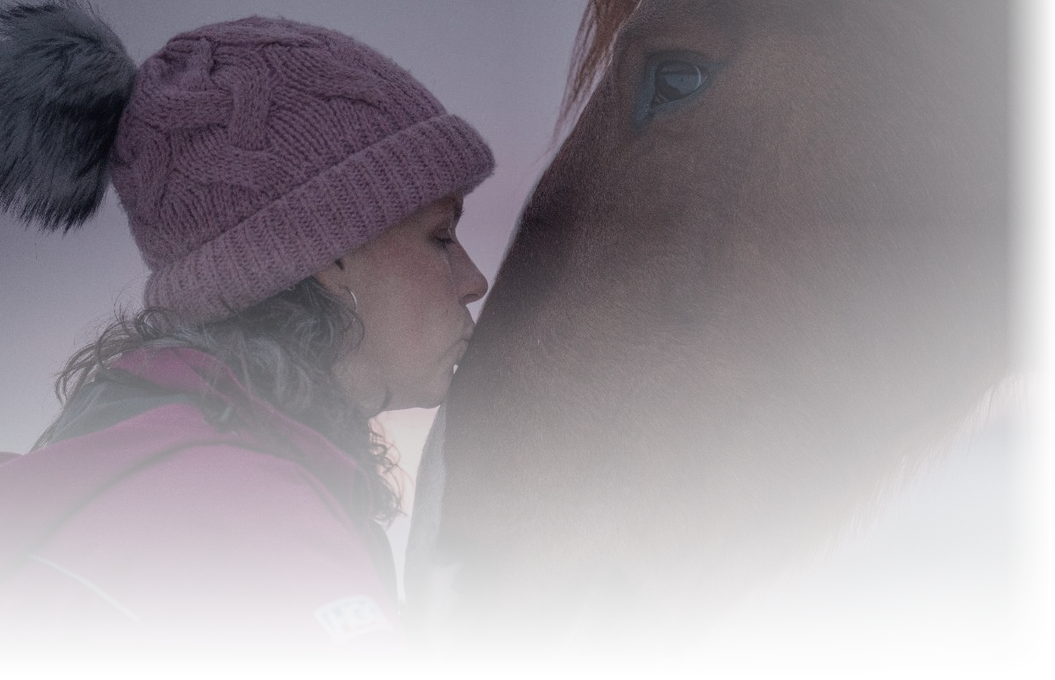
What exactly is difficult for you right now?
That’s the question I’d like to ask a horse that won’t go into the trailer.
The question came up in the Masterclass. Someone in the audience asked what it could be when a horse won’t load. I thought: we need to talk about this in the podcast, because so many of us have been there. What is actually going on when a horse doesn’t load well, or won’t load at all? And what if he gets in, but struggles on the journey?
Traditionally it starts with: stupid nag. If we’re feeling a bit kinder, we say: he must have had bad experiences. And the moment we’re stuck with the trailer and not getting anywhere, we suddenly have a big audience around us, and every one of them has a good tip. Maybe someone even asks whether the horse can see well enough.
My view has shifted a little over the years. I often see things that go beyond typical learning behaviour. Of all my horses, Despino was the one who always had the most trouble loading, and I just couldn’t understand what I was doing wrong. I’d practised so much! Once we drove to a course, the journey there was fine, and on the way home he refused to get back in. All I had to do was swap him from the right side to the left. On the side he’d travelled on, something had frozen onto the ramp on the way, and he didn’t see how he could possibly step over it. I’m still a little bit ashamed of how I handled things at one point or another.
Listen and subscribe: Spotify · Apple Podcasts · Deezer · YouTube
1. Vision: what does your horse see at the trailer entrance?
A horse sees the world differently from us. His eyes sit on the sides of his head, so he sees almost all the way round, but he has two blind spots: one right in front of his forehead and one right behind him. The area where both eyes look forward together is much smaller than ours. In that area, he judges distances well. What’s very close to his nose, he probably sees less sharply.
So he may not be able to see the edge of the ramp all that well when he’s meant to step onto it. He has to move his head. To look at the ground he lowers it, and for what’s further ahead he raises it. If I hold him on a very short rope, I take away exactly that chance to look at the ramp. Most horses are really happy when they can sniff and have a good look at the ramp, whiskers included. In my experience, a huge amount of stress goes out of the loading situation when we stop, let the horse look and let him sniff.
Light and dark
Then there’s the change from light to dark. When we walk from the sun into the trailer, the horse is facing a dark hole. There’s a very simple fix: if it’s bright outside, make sure it’s bright inside too. Lots of trailers have lighting these days. I find, and many of my students tell me the same, that they have more trouble loading horses into trailers that are dark inside than into trailers that are light and friendly. So put the ceiling light on, and you’ve already made it a good deal easier for him. To us it’s the same trailer. For the horse, the way the light falls can change the whole situation.
I always travel with the little light on, too. I have the feeling it helps my horses keep their bearings and not react so sensitively to the headlights outside. If you have an old trailer without a light: there are really simple LED lights that run on batteries. Two of those on the ceiling, and that’s sorted.
There’s a study on this as well: Claire Neveux and her team loaded young trotters with little trailer experience under strong, even LED lighting. The horses went in faster and showed less stress behaviour. An earlier study with eight horses found no effect of the lighting (Cross et al. 2008).
2. Proprioception: what’s happening under his feet?
A typical situation: the horse stands with his front feet on the ramp, his hind feet are still down on the ground, and then he won’t go any further. Before we ask why, let’s look at what he actually has under his feet. At the back he’s still standing on the yard, where the ground is usually nice and firm. At the front, the ground sounds different, feels different, and if we’re unlucky it wobbles too. And if we’re even more unlucky, the ramp has anti-slip strips. They’re good so horses don’t slip, but in my experience they’re a nightmare for horses who struggle with proprioception.
The word sounds abstract very quickly, but it really isn’t. Proprioception is the perception of the position and movement of your own body in space, including on different surfaces. You can feel where your foot is: whether it’s on the floor or in the air, whether you’ve got wood, carpet or tiles under your feet. It just runs along in the background, and it’s exactly the same for horses.
There are lots of reasons why proprioception can be limited. One is too little exposure: the classic stabled horse, 23 hours inside and one hour on a small sand paddock. He lacks practice, and that can be trained. Then there are horses who struggle with perception for other reasons, for example neurological impairments in the neck.
What I see with Despino
Despino has a neurological impairment. I notice it, for example, because a hose lying somewhere other than where it usually is, is more or less game over for him. Poles at a fixed distance are no problem. If I lay them out irregularly, the task gets harder for him with every repetition, because he can’t judge the distances properly. With another horse, the same thing gets better each time.
Practice only gets you so far here. It takes plenty of patience and elbow grease. Every time something changes (a different trailer, a ramp that isn’t quite straight, something frozen onto the ramp) it’s game over for him again. When I understand that he isn’t being unwilling but is truly panicking in that moment, because he doesn’t understand what’s happening in his body, I can be so much more patient. With horses like this, luring them with a carrot or a feed bucket often doesn’t work, because the fear of not trusting their own body is so much bigger. What helped Despino enormously is a mare of his own who simply goes ahead. Since then, he gets into the trailer.
3. Balance: the journey is a task in itself
The journey is part of loading, and it’s a task in itself: the horse has to cope with braking, setting off and corners, perhaps with driving uphill and downhill as well. I’d recommend this to everyone: stand in the empty trailer yourself, ride along for a lap, and get a feel for how hard it is to keep your balance. Now, we could say horses have four feet. But the horse doesn’t know what’s coming next.
Proprioception plays a part here too. For a horse with limited proprioception, these balancing movements are much harder, because the floor isn’t standing still. We notice the difference between a standing trailer and setting off, and that’s something we have to practise as well.
A colleague of mine practised this beautifully with her young horses: she put them in the trailer, drove 150 metres to the next pasture and let them graze there. In the evening they went back, the same routine for many days. It only wobbled for a moment, but it was a positive experience at both ends: plenty of grass on one side, their familiar herd on the other. I’ve never seen horses get in and out as well as hers. I’d recommend it to anyone who has the chance: drive to friends round the corner or to other training places now and then, make the journey a routine, drive with foresight and avoid strong acceleration.
4. Load and endurance: trailer travel is physical work
Trailer travel is physical work. There are various studies that have measured values. What I miss in all of them, in the study design, is the horses’ state of training.
As a thought experiment, I like to take ten minutes of continuous trot: would I trust my horse with that today? If my horse can’t manage five minutes in a row on the circle when I’m lungeing him, the trailer is probably very hard work for him too. That’s the moment when we have to think about his state of training.
Looking back, it makes a lot of sense to me. I used to drive for many hours to a course with my horses, and I was always puzzled why their performance was so poor in the first few days. Today I understand: a trailer journey of eight, nine, ten hours is an enormous physical strain, especially for horses who aren’t used to it.
If you’re properly nerdy, you can strap a heart rate monitor on your horse and see which load zone he reaches on the journey, and whether he settles after a few minutes or stays high. Then I can also see how fit my horse is in everyday life and whether I can prepare him better. Sometimes we have to go to the clinic, and then it’s good if the body is fit enough to cope with that well.
5. Pain and instability in the hindquarters
Many horses are affected by this, and with many we don’t think of it at all. Pain and instability in the hindquarters are a pretty big drama for horses in the trailer. Since trailer cameras exist, we can observe horses really well during the journey. Sometimes it honestly looks wild: the horse loses strength, gives way at the back or leans against the trailer wall because he’d fall otherwise. Footage like that can show us where the journey gets difficult. In my experience, there can be a pain component behind a horse’s unwillingness to load. Lack of strength can play a part as well, but in my experience that’s rarely the case.
If you suspect something, I’d simply put a camera in the trailer. Dashcams are very cheap these days, too, and you can let them run on your phone via Bluetooth, not while you’re driving, but for your passenger. That way you can do a test drive and see whether the horse has trouble balancing and standing properly. If there’s a pain cause behind it, that’s a case for the vet, and you’re very welcome to take the footage along.
6. Learning: it comes in, but not first
And now learning comes in. I’ve talked about so many other things before we even look at the pure topic of learning. These physical difficulties are a learning experience too: the horse sees the trailer and slows down on the way to it. When the trailer’s standing still it usually still goes reasonably well, but for the horse it’s also an announcement of what’s about to come.
The very first thing to do is practise with time, calm, patience and kindness. In my experience, horses without impairments in their perception of the outside world and of their own bodies learn this very quickly, even if they’ve had bad experiences, and the bad experience can be overwritten with positive ones. If a horse has had bad experiences for ten years, I may have to practise for longer than if he’s only had a bad experience twice. With a horse whose perception is limited, who doesn’t trust his own feet, it’s a completely different story. We need much more patience and can never say that it’s now learned. It’s always about the form of the day, too.
If we notice that it isn’t getting better with practice alone, we’re allowed to look wider. And if other things come in, for example if the horse finds it hard to stand on three legs while you pick out his hooves, or has trouble with poles, or finds new situations difficult, then that’s an invitation to look wider.
In conclusion: a horse who stops at the ramp isn’t simply unwilling
He’s giving us feedback: at this point it gets difficult. Then we can rule things out, one by one:
- Can the horse see?
- Has he met enough different stimuli and surfaces?
- Has he practised at all?
- Are there physical reasons we should rule out?
If I’d known earlier that Despino has a neurological impairment, I could have helped him so much better. Thinking trailer training through means starting with the question: what exactly is difficult for you right now? And not letting ourselves be fobbed off with the explanation: twenty years ago he had a bad experience.
Frequently asked questions
Why won’t my horse go into the trailer? Possible reasons are vision and light, body awareness, balance during the journey, load and endurance, pain or instability in the hindquarters, and learning. A horse who stops at the ramp isn’t simply unwilling, but is giving us feedback on where it gets difficult.
What can I do about a dark trailer? If it’s bright outside, make it bright inside too, with the ceiling light or two simple battery LED lights. And give the horse time to look and sniff.
What is proprioception? The perception of the position and movement of your own body in space, including on different surfaces.
What can I do if I suspect pain as the cause? Let a trailer camera or dashcam run and do a test drive. If there’s a pain cause behind it, that’s a case for the vet, and you can take the footage along.
Enjoyed the episode? Then do subscribe to Equidemia Insights – Rethinking Horse Training on Spotify, Apple Podcasts, Deezer or YouTube, follow us on Instagram and Facebook, and send the episode to the one horse person in your yard who needs it.
Sources and further reading
Neveux C, Ferard M, Melac E, Pousset N (2023). Effects of different LED lighting conditions on young horses during trailer loading and stationary confinement. Applied Animal Behaviour Science 261:105885. https://doi.org/10.1016/j.applanim.2023.105885
Cross N, van Doorn F, Versnel C, Cawdell-Smith J, Phillips C (2008). Effects of lighting conditions on the welfare of horses being loaded for transportation. Journal of Veterinary Behavior 3:20-24. https://doi.org/10.1016/j.jveb.2007.07.005